
By Sree Bhat
HRH Crown Prince and Prime Minister Mohammed bin Salman’s invitation captures the scale of the Kingdom’s ambition as it pursues an economy increasingly built around data, artificial intelligence and advanced computing.
The ambition is no longer confined to strategy documents. Saudi Arabia is rapidly building the physical infrastructure to support an AI economy – from hyperscale data centres and computing capacity to cloud platforms, advanced chips and industrial applications.
While much of the region has been dealing with the immediate consequences of the regional conflict, missile attacks, disrupted energy flows and uncertainty, Saudi Arabia has continued to pursue some of its most ambitious investments in a very different future.
Amid the noise, Saudi Arabia is building an infrastructure platform on a scale designed not simply to consume AI but to host it.
The big numbers
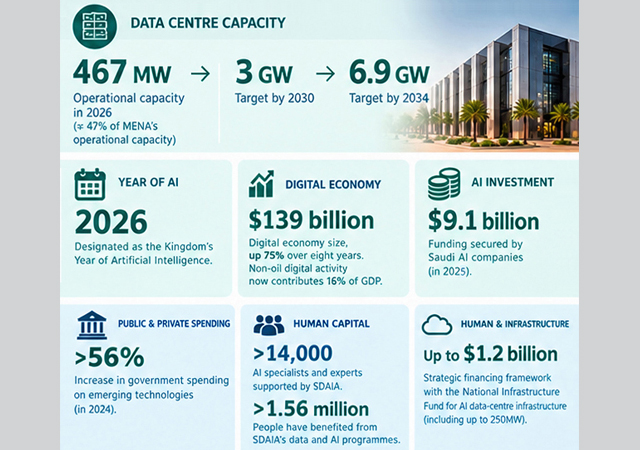
Already, the Kingdom’s digital economy has grown 75% over eight years to $139 billion. Non-oil digital activity now contributes 16% of GDP, according to reports.
Operational data-centre capacity reached 467MW in 2026, accounting for about 47% of MENA’s operational capacity. The Kingdom is targeting 3GW by 2030 and 6.9GW by 2034.
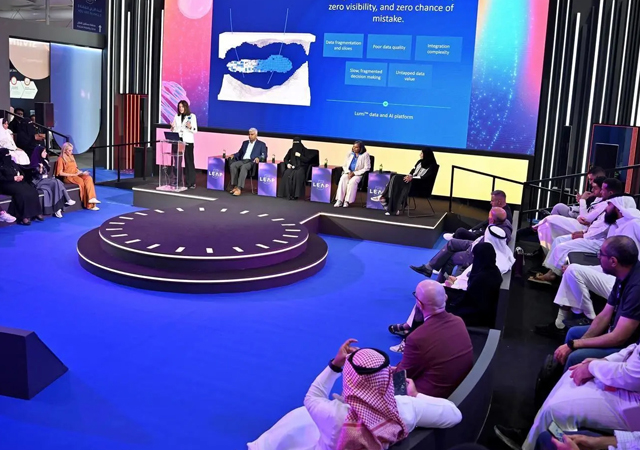
Speakers at the Tech Arena of LEAP 2026 … future-focused
That build-out is supported by Saudi Arabia’s unusual combination of capital, relatively low-cost energy, vast land availability, a large domestic market and the ability to deploy infrastructure at national scale.
Communications and Information Technology Minister Eng Abdullah A Alswaha has described the Kingdom’s advantage in the AI era in simple terms: compute, customers and capital.
The AI push is already attracting substantial private and institutional capital. Saudi Data and AI Authority (SDAIA) figures show that Saudi AI companies raised $9.1 billion through nearly 70 investment deals in 2025, underscoring the rapid growth of the domestic AI ecosystem.
The Kingdom is also putting major capital behind the infrastructure needed to support that growth. Aramco has acquired a significant minority stake in HUMAIN, a PIF company, advancing a full range of AI capabilities globally, while HUMAIN secured up to $1.2 billion in financing from the National Infrastructure Fund.
AWS has separately committed $5.3 billion to expand its cloud infrastructure in the kingdom, alongside a planned AI Zone investment with HUMAIN of more than $5 billion. Saudi Arabia has also been developing plans for a $40 billion AI investment fund, signalling the scale of capital it is prepared to mobilise as it seeks to build a domestic AI ecosystem, a report said.
The scale of the broader technology build-out became clearer at LEAP 2026, where Saudi Arabia announced nearly $15 billion in investments, agreements and projects spanning AI infrastructure, data centres, cloud computing, technology manufacturing and venture capital. More broadly, technology-related infrastructure commitments announced since the launch of LEAP in 2022 had exceeded $42 billion by early 2025, including a record $14.9 billion in AI investments announced at LEAP 2025, according to estmates.
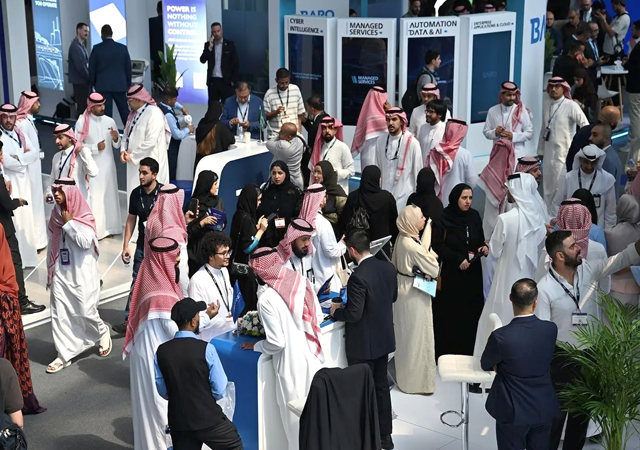
Nearly $15 billon investments were announced at LEAP 2026
The numbers illustrate the breadth of capital now being mobilised around the Kingdom’s AI strategy. HUMAIN is also seeking billions of dollars in additional financing to expand its data-centre capacity, while the wider Saudi data-centre pipeline could require tens of billions of dollars in capital.
Taken together, the investments, financing and planned funds show that Saudi Arabia’s AI strategy goes well beyond developing applications: the Kingdom is seeking to build the computing power, data-centre capacity, cloud infrastructure and domestic companies needed to establish itself as a major AI hub.
From infrastructure to applications
In September, Alswaha travelled to Silicon Valley and met OpenAI CEO Sam Altman and senior executives to discuss advanced AI models and the use of computing infrastructure being developed by Saudi AI company HUMAIN to support large-scale model deployment and national AI applications.
Meetings with Dell Technologies and Cognition similarly focused on enterprise AI, knowledge transfer, national capability development, autonomous software engineering and improved developer productivity.
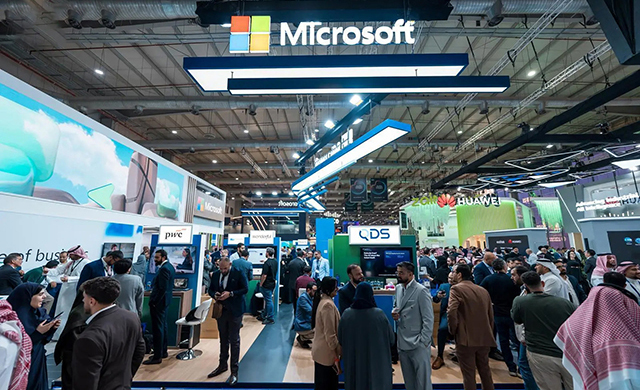
Microsoft and Aramco have partnered to advance industrial AI
These meetings and the recent investments clearly show that Saudi Arabia is beginning to connect the different layers of the AI economy – computing infrastructure, models, applications, enterprises, talent and investment – rather than simply becoming a large buyer of GPUs and data-centre capacity.
Other partnerships involving AMD, Cisco and international technology companies are expanding the potential scale further, with plans pointing towards gigawatt-scale AI infrastructure by the end of the decade.
The question, however, is what will run on all that compute.
Energy advantage
This is where Saudi Arabia’s AI story becomes particularly interesting. The Kingdom is not approaching artificial intelligence as a technology sector isolated from the rest of the economy. It can use AI to extract more value from the industrial assets it already possesses – particularly energy, refining, petrochemicals, chemicals and logistics.
Saudi Aramco is already providing an indication of what that could look like.
Aramco says it generated $2.6 billion in AI-driven Technology Realised Value in 2025, part of a total $5.3 billion in technology-related value. It has identified 442 AI use cases, with more than 200 solutions deployed and another 100-plus in development.
The relationship between AI and energy runs in another direction too. The rapid expansion of AI is creating enormous demand for computing power and, consequently, electricity – potentially giving Saudi Arabia another advantage through its energy resources.
Aramco’s partnership with Microsoft to advance industrial AI, digital talent and the co-innovation and commercialisation of industrial AI intellectual property is also significant. It points towards a model in which Saudi Arabia is not merely importing technology but also developing and commercialising technology around its own industrial strengths.
The same principle is beginning to appear outside hydrocarbons. Aramco and Ma’aden, for example, are combining subsurface expertise, AI and high-performance computing to explore copper and other minerals across a huge area of the Kingdom.
AI is, therefore, becoming part of Saudi Arabia’s broader industrial strategy.
The real prize is productivity
Yet the bigger question is becoming harder to avoid: Can the Kingdom turn the enormous capital being deployed into AI into productivity, intellectual property, competitive companies and lasting economic value?
The IMF’s latest analysis of AI in the Middle East and Central Asia estimates that AI adoption could raise Saudi Arabia’s real GDP growth by 0.1 to 0.4 percentage points annually over the next decade.
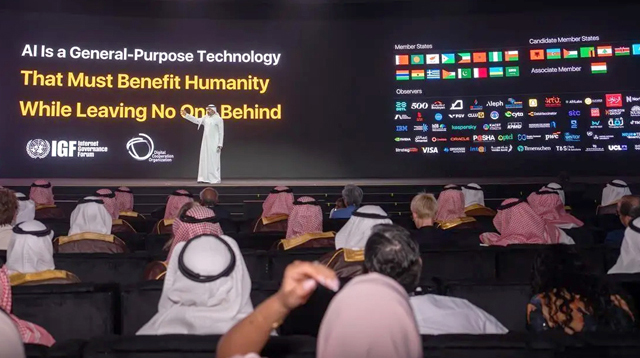
Saudi Arabia aims to use AI to extract more value from the assets it already possesses
In a more optimistic scenario involving stronger investment, improved preparedness and greater exports of AI services, the gain could reach 0.6 percentage points annually, potentially lifting GDP by up to 6% over a decade.
That is significant – but it is also a reminder that the value has to come from adoption.
Local capability matters
Saudi Arabia’s localisation agenda may ultimately prove more important than the headline data-centre numbers.
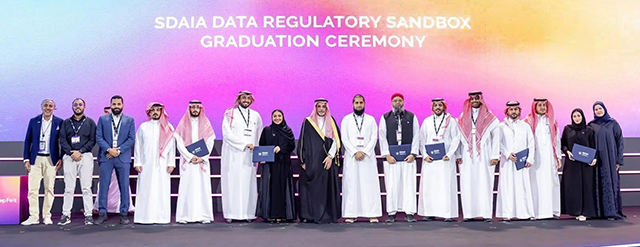
SDAIA helps in skills development
If Saudi Arabia builds the servers but imports the models, engineers, intellectual property and applications, much of the long-term economic value will remain elsewhere. If the infrastructure instead helps Saudi companies develop proprietary applications, train specialised models, build AI engineering capabilities and export services, the economics change substantially.
That makes the technology partnerships important not just for access, but for knowledge transfer and the development of domestic capability.
Building ahead of demand
There is, nevertheless, a significant risk. AI infrastructure is extraordinarily capital-intensive. Data centres consume enormous amounts of electricity and require sophisticated cooling, networking and chip infrastructure.
Technology also changes rapidly, creating the possibility that infrastructure designed around today’s requirements may be less competitive tomorrow. The bigger risk is building computing capacity faster than the domestic and international demand required to make it economically productive.
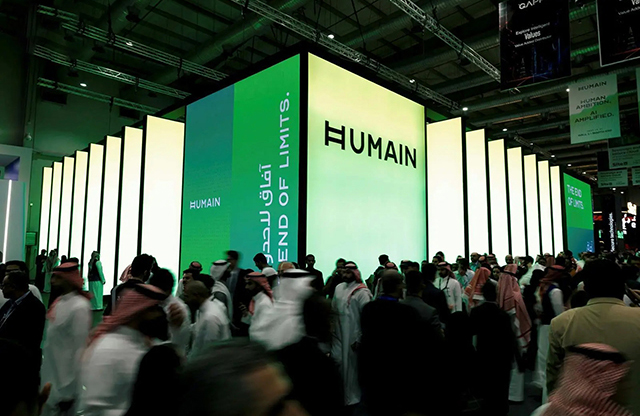
HUMAIN is central to Saudi Arabia’s AI ambition
The IMF has warned that large-scale AI infrastructure investment could create financial vulnerabilities if adoption and returns fall short of expectations. It also highlights the risks of job displacement, skills mismatches and inequality. The challenge is therefore not simply to build more. It is to build the right things.
Towards AI economy
The Kingdom has several advantages few countries can combine: enormous capital resources, abundant energy, major industrial companies, large datasets, engineering expertise, a sizeable domestic market and the ability to deploy technology at scale.
Saudi Arabia’s AI story will not ultimately be measured by the number of gigawatts of data-centre capacity it builds, the number of GPUs it installs or its position in global AI rankings. It will be measured by whether compute becomes productivity, data becomes intellectual property, investment becomes competitive companies, and localisation becomes capabilities that endure long after the current AI infrastructure cycle has ended.