
By Sree Bhat
The Middle East’s push into industrial AI is being driven by government-backed national strategies, heavy investment in data centres and cloud infrastructure, and efforts to build local capabilities.
Over the next three to five years, AI is expected to reshape industrial operations, driven not only by technological advances but also by a shortage of traditional operational skills that will create greater scope for technology-related roles. The shift will increasingly be from humans operating systems to humans supervising more autonomous operations, making connected, contextualised operational data a strategic asset, says Nayef Bou Chaaya, Vice President, Middle East, Türkiye and Central Asia, AVEVA, discussing what sets the region apart and the opportunities and challenges in deploying industrial AI across traditional industries in an exclusive interview with Tech Arabia.
Excerpts from the interview:
The Middle East is investing heavily in AI and industrial transformation. What distinguishes the region’s adoption of industrial AI from other markets?
Governmental support is what distinguishes the most Middle East. Currently the region is building data centres, cloud infrastructure and developing local skills as a foundation for AI adoption, giving companies the chance to build AI into their systems from the start.
National strategies in place in countries like the UAE, Saudi Arabia or Qatar have made industrial AI a priority, encouraging companies to move beyond pilot projects. The region’s large energy and industrial companies are deploying AI at scale and applying AI across their operations to achieve optimised performance.
What are the biggest barriers to moving industrial AI from proof-of-concept to enterprise-wide deployment?
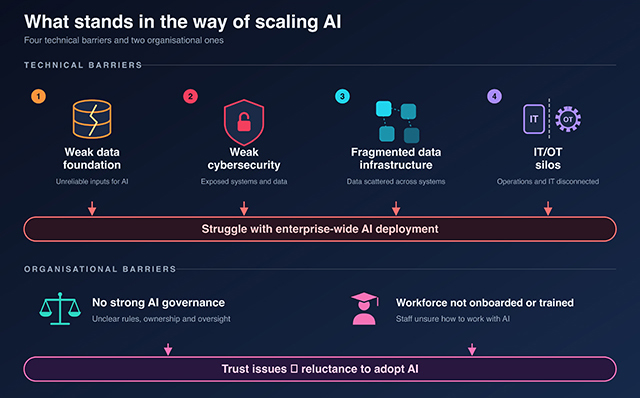
I see four main technical barriers to AI scalability: a company that has a weak data foundation, a weak cybersecurity, fragmented data infrastructure, and IT/OT silos will struggle with enterprise-wide deployment of AI. In addition to the technical obstacles, if a strong AI governance is not in place and if the workforce is not properly onboarded and trained on how to work with AI, issues of trust will result in reluctance to adoption.
How can industrial intelligence, AI and real-time data analytics help utilities stabilise increasingly complex power grids?
Utilities are being asked to run more dynamic, bi-directional and weather exposed grids, while integrating renewables, small and decentralised energy assets and new demand spikes. As a consequence, grid stability increasingly depends on real-time situational awareness. Using AVEVA capabilities such as AVEVA PI System (to collect, cleanse, store, enrich and visualise real-time operations data) and an AI ready data foundation, utilities can unify OT/IT signals (e.g., substations, sensors/smart meters, SCADA and external context) into a single operational picture. They can trigger automated alerts and apply AI/ML-driven predictive analytics (pattern recognition, anomaly detection, root-cause analysis) to anticipate issues before they cascade into outages. In practice, this kind of real-time analytics can help operators see grid conditions as they evolve, prioritise interventions, and respond faster to disturbances – supporting more reliable operations as grid complexity rises.
How can AI and data-driven innovation help create a more secure, resilient and sustainable energy system?
CONNECT is our “AI infused” industrial intelligence environment that unifies data, digital twins and analytics to optimise efficiency and maximise sustainability across the industrial lifecycle –helping energy systems operate more securely and sustainably as complexity grows. In a very pragmatic way, monitoring operational data leads to a better understanding of the strengths and weaknesses of processes. Using AI accelerates the optimisation journey and leads to reduced energy consumption and to a more sustainable use of resources.
Where are you seeing the strongest business cases for AI today?
The top three business cases for industrial AI are: Predictive maintenance & asset reliability to avoid expensive downtime and to preserve safety in operations; Process optimisation with prescriptive analytics that influence throughput, yield, quality; and Energy & emissions optimisation to foster decarbonisation at scale while keeping operations efficient.
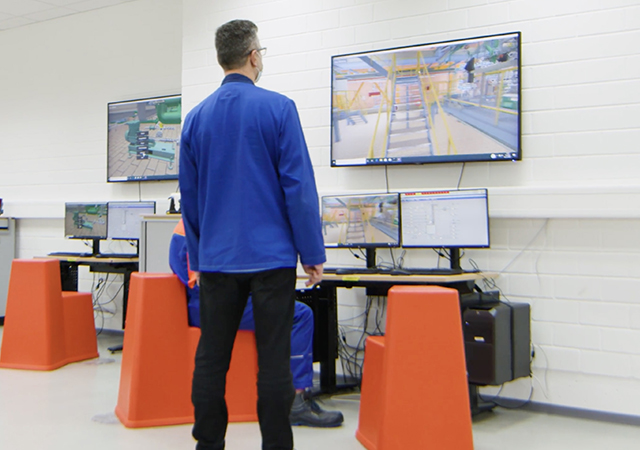
CONNECT unifies data, digital twins and analytics
How are AI, digital twins and industrial software helping companies optimise production without increasing their environmental footprint?
To help companies optimise production without increasing environmental footprint, AI, digital twins and industrial software connect real-time operational data to models that can continuously improve how plants run. Industrial AI is a strong enabler for plants to operate at optimal production levels for maximum efficiency, and this translates directly into reduced waste and maximised yield. As AI also empowers teams to anticipate early issues, unnecessary maintenance and resource use can be avoided – supporting lower emissions while maintaining output. Digital twins are live, continuously synchronised representations of assets and processes that use real-time data. They enable “what-if” testing, early anomaly detection and performance optimisation including energy efficiency. Using digital twins, organisations can trial improvements digitally rather than experimenting on production systems.
Looking ahead 3 to 5 years, what do you think will fundamentally change in the way industrial companies operate as AI becomes embedded in their core systems?
In three to five years, we can expect changes in the industry as the adoption of AI will continue to spread. But the change we will observe won’t only come from the technology. The shortage of traditional operational skills will force the industry to reinvent itself, leaving more room to technology and technology related roles.
The biggest change will be a shift from humans operating systems to humans supervising more autonomous systems. For Middle East companies, preparation starts with the foundation. AI is only as good as the data beneath it, so the priority now is to connect and contextualise operational data across sites and systems, and to treat this as a strategic asset.
How can companies align digital transformation with regional net-zero and energy-transition objectives?
Industrial digitalization consists in leveraging data to monitor and improve continuously and consistently industrial performance and sustainability. Well managed, industrial data can provide operators with a wealth of information which, combined with AI, can turn into recommendations to reduce CO² emissions or energy consumption for instance. This is what we call Industrial intelligence. Similarly, AI can be used to recommend the most sustainable energy sources available for the operations to reach their energy transition objectives.
How is the emergence of generative AI and industrial AI changing what digital twins can do?
Generative AI and industrial AI boost capabilities of digital twins: from static or periodically updated representations they have become continuously learning, decision-support systems that can be built and operated at greater scale.
Industrial AI enables the digital twin to analyse operational data, detect anomalies, predict outcomes, and recommend actions in real time.
With Industrial AI assistants built with LLMs/GenAI, engineers and operators interact with the digital twin through natural language to investigate abnormal performance, identify root cause, or even to prepare maintenance actions. This is new.
AI is also changing how twins are created: “AI-assisted twin building at scale” reduces manual effort so digital twins can become repeatable, enterprise-wide foundations for analytics and operational optimisation rather than one-off projects.