

By Sree Bhat
Artificial intelligence is rapidly reshaping the cyber battlefield in the Middle East, making attacks quicker, cheaper and more sophisticated, while driving the financial impact of data breaches to unprecedented levels.
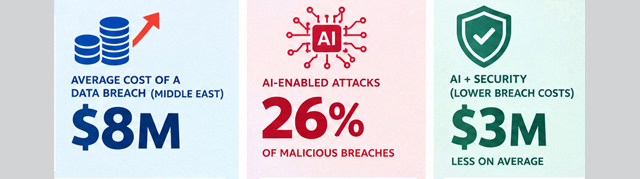
According to IBM’s 2026 Cost of a Data Breach Report, the average cost of a data breach in the region has climbed to $8 million, making cybersecurity not only a technology challenge but a major business risk. More significantly, over one in four malicious breaches (26%) were AI-enabled, underscoring how cybercriminals are increasingly exploiting artificial intelligence to automate and scale their attacks.
The report suggests that the economics of cybercrime are shifting dramatically. While attackers are using AI to reduce the cost and complexity of launching sophisticated campaigns, organisations are facing rising expenses to detect, contain and recover from breaches.
“As the number of cybercriminals harnessing the power of AI for malicious purposes rises, attacks are becoming faster and cheaper to launch, while breaches keep getting more expensive to find and fix. This growing imbalance is fundamentally changing the economics of cyber risk,” said Saad Toma, General Manager, IBM Middle East and Africa.
He said businesses must invest in AI-powered threat detection, security automation and rapid response capabilities to stay ahead of sophisticated attacks.
AI as the defender
The report also highlights AI’s growing role as a defensive tool.
Organisations that had extensively deployed AI and security automation recorded breach costs that were more than $3 million lower on average than companies without these capabilities. Despite the clear financial benefits, nearly a quarter (23%) of surveyed organisations had yet to adopt AI-driven security solutions.
Weak security practices drive costs
IBM identified three major factors that significantly increased breach costs for Middle East organisations:
• Mismanaged secrets and encryption keys
• Excessive user privileges and poor identity management
• Failure to prioritise security threats effectively
Conversely, companies that adopted strong encryption, integrated security into software development through DevSecOps, and deployed endpoint detection and response (EDR) technologies experienced substantially lower breach costs.
The biggest price
The financial damage extends far beyond technical recovery. Lost business accounted for the largest share of breach costs, averaging $3.57 million per incident. Post-breach response activities added another $2.17 million, while detection and escalation cost $1.9 million. The figures illustrate how cyber incidents now affect every stage of business operations – from customer trust and operational disruption to legal compliance and recovery efforts.
The study, conducted by the Ponemon Institute and sponsored by IBM, analysed data from 602 organisations that experienced data breaches between March 2025 and February 2026. The findings reinforce a growing reality: as cybercriminals embrace AI to reduce the cost of attacking, organisations that fail to invest in AI-powered security risk paying an increasingly heavy financial price.