

By Abdulaziz Khattak and Abbinaya Kuzhanthaivel
As Saudi Arabia accelerates its drive to build an artificial intelligence economy, the next challenge may not be access to the latest AI chips but having the power, cooling and data-centre infrastructure needed to put them to work.
That is where Submer, a global sustainable data centre and liquid-cooling infrastructure provider, sees a growing opportunity in the Kingdom.
The company is working with two partners to explore the local assembly of mechanical and electrical data-centre modules, while offering services and products across the wider AI and high-performance computing infrastructure stack.
Speaking exclusively to Tech Arabia at LEAP 2026, Rabih Al-Khnaizi, Regional Sales Director for KSA at Submer, said Submer aims to address the infrastructure requirements emerging as Saudi Arabia rapidly expands its AI capabilities.
Submer describes itself as “a full stack AI infrastructure service and products firm”, serving AI and HPC data centres across the stack.
“We go from the chip on top to the land at the bottom, and everything in between,” Al-Khnaizi said.
Its offering covers power, mechanical and electrical systems, thermal cooling, IT design and software, with the business divided broadly between services and products.
On the services side, Submer works with customers to define use cases, develop RFPs, design infrastructure and develop AI/HPC data-centre strategies and amortisation plans. On the products side, it addresses the physical infrastructure needed for high-density computing, including MEP systems, power and thermal management and direct-to-chip liquid cooling.
AI readiness goes beyond GPUs
For Al-Khnaizi, one of the central issues facing the Saudi market is that AI readiness cannot be measured simply by access to advanced processors.
“It’s not only based on the GPU or the AI chip,” he said.
Data centres must first be capable of supporting the power density and heat generated by next-generation AI hardware. Direct liquid cooling is becoming increasingly important as GPU densities rise, while power availability is becoming a fundamental consideration in data-centre planning.
“Before we were defining that centre based on the number of processors. Now we’re defining the centre on the power capacity,” Al-Khnaizi said.
The shift means operators increasingly have to consider how many megawatts a facility can support and how efficiently the resulting heat can be removed.
He said much of the required infrastructure in Saudi Arabia is still being planned, developed or constructed, creating an opportunity for companies able to provide the physical systems required to host high-density AI computing.
Modular approach to faster deployment
Submer’s answer includes a modular approach to data-centre infrastructure, allowing capacity to be deployed in phases rather than requiring an entire facility to be completed before it becomes operational.
Al-Khnaizi compared the concept to Lego bricks, with modules assembled to provide initial capacity and additional modules added as demand grows.
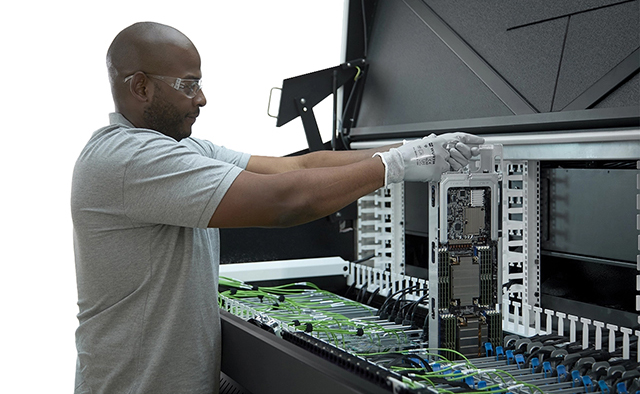
A customer could, for example, start with a 10MW facility and subsequently expand it in stages without disrupting the capacity already in operation.
“You can work in phases,” he said. “You can expand in phase one, phase two, phase three, without disrupting what is being operational in the first phase.”
The approach is also intended to address one of the industry’s biggest challenges: the speed at which AI hardware is evolving.
“You cannot wait for two, three years to build a data centre,” Al-Khnaizi said. “If you wait for two years, there are two generations of AI chips that came in, and then your order is already obsolete.”
Modular mechanical and electrical systems can be assembled in a factory while site preparation takes place, allowing them to be delivered and integrated more quickly. For Saudi Arabia, the approach could also support the Kingdom’s localisation objectives.
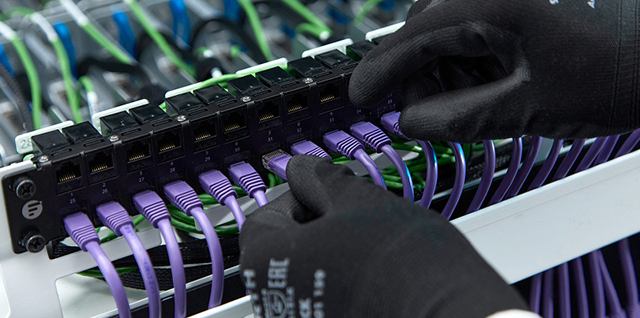
The company is working with two partners on bringing local assembly of mechanical and electrical modules to Saudi Arabia.
“There is a huge demand,” Al-Khnaizi said. “The entire Saudi government is going this way. And this is why we are trying to bring partners to assemble here in Saudi.”
Enabling GPU-as-a-service
The infrastructure build-out is closely linked to another emerging opportunity: GPU-as-a-service.
Al-Khnaizi distinguishes between the large GPU clusters used to train AI models and the infrastructure required by businesses that want to use those models for applications and inference.
He expects the latter to become an important part of Saudi Arabia’s AI adoption as companies seek access to high-performance computing without necessarily building their own large-scale GPU infrastructure.
“Realistically speaking in Saudi, this is the main function that will be happening as companies need to adapt on AI,” he said. ==
But GPU-as-a-service also depends on the availability of data centres equipped with sufficient power and high-density cooling.
“To be able to have this ready in Saudi, you need the data centre to be ready to host the GPU,” Al-Khnaizi said.
This is where Submer’s full-stack proposition comes into play, combining consulting, design and infrastructure products rather than focusing on a single component of the AI data-centre.
Rapid AI adoption
Al-Khnaizi believes the pace of change in Saudi Arabia has been particularly striking.
“One year ago, there was no talk about AI. It was not available. There was zero demand,” he said.
“Now we’re talking about 2026. LEAP is all about AI.”
He attributes the acceleration to the wider environment in the Kingdom, including government support and regulation, which are helping businesses adopt emerging technologies rapidly.
The scale of the infrastructure opportunity is correspondingly large. Al-Khnaizi pointed to 12GW of power capacity for data centres as an indication of the potential demand expected over the next three to four years.
“Imagine the demand that’s coming in the coming three, four years,” he said.
For Submar, the opportunity is to combine infrastructure expertise with local assembly and engineering capabilities as Saudi Arabia builds the physical foundations of its AI ambitions.
The race to deploy increasingly powerful processors is only one part of the equation. Those processors need data centres, and those data centres need power, thermal management, cooling and increasingly sophisticated mechanical and electrical systems.
For Al-Khnaizi, Saudi Arabia’s rapid movement into AI means those infrastructure elements will have to develop at the same pace as the technology they are designed to support.