
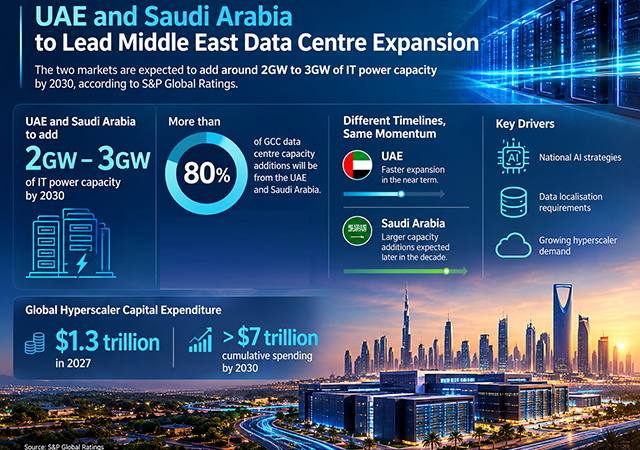
The UAE and Saudi Arabia are set to lead the Middle East’s data centre expansion, with the two markets expected to add around 2GW to 3GW of IT power capacity by 2030, according to a new report from S&P Global Ratings.
The two countries are expected to account for more than 80% of data centre capacity additions in the GCC, with the UAE moving faster in the near term while Saudi Arabia’s larger capacity additions are expected later in the decade.
National AI strategies, data localisation requirements and growing hyperscaler demand are supporting the expansion. S&P expects global hyperscaler capital expenditure to reach $1.3 trillion in 2027, with cumulative spending exceeding $7 trillion by 2030.
The report said strict data localisation regulations and sovereign cloud policies are increasing demand for domestic data centres and encouraging partnerships between global hyperscalers and local operators.
Telcos become infrastructure partners
Telecommunications operators are playing a growing role in this expansion by providing data centre capacity alongside the fibre, mobile and subsea connectivity needed to support cloud and AI workloads.
“Telecommunications operators (telcos) in the GCC region spur the data centre boom by providing the critical infrastructure and connectivity to support the growing demand,” S&P said.
Rather than building and owning all facilities themselves, GCC telcos are increasingly partnering with hyperscalers, sovereign wealth funds and other investors, often through minority stakes. The report said this partnership-led approach should limit the impact on telcos’ cash flows and capex compared with full ownership.
S&P expects capex intensity among rated and publicly listed GCC telcos to average 15% - 20% of sales between 2026 and 2028, compared with about 10% - 15% between 2023 and 2025.
Partnerships reshape the market
Several operators are already using this model to expand their data centre footprint.
Saudi Arabia-based center3, a wholly owned subsidiary of stc, has formed a joint venture with HUMAIN to develop and operate a data centre with capacity of up to 1GW by 2030.
Ooredoo plans to increase its data centre capacity from 26MW to 120MW, while Bahrain-based Beyon is using joint ventures to expand its presence in existing facilities in Jordan and Bahrain.
At the same time, ownership of the region’s data centre capacity is becoming more diverse.
Telco-owned facilities currently account for around 30% - 35% of total IT power capacity in the Middle East, but S&P expects the telco-owned share of new capacity additions to fall below 10% between 2026 and 2030 as sovereign wealth funds, private equity firms and other investors take a larger role.
Connectivity remains central
Telcos are also investing in the networks needed to connect the growing number of data centres. S&P highlighted investments in fibre and subsea cable infrastructure, including Ooredoo’s “Fibre in Gulf” project and du’s “Singapore India Gulf” cable.
These investments are expected to strengthen connectivity between data centres, cloud platforms and customers while opening additional revenue opportunities for telecom operators.
The report also points to relatively favourable energy economics as another factor supporting the region’s growth. Average data centre construction costs between 2026 and 2030 are estimated at around $11 million per MW in the UAE and $13 million per MW in Saudi Arabia, broadly comparable with Europe and North America.
Telcos face a broader role
S&P expects telecom operators will remain central to the data centre boom in the Middle East. “We expect they will evolve from simple connectivity enablers to integrated infrastructure partners,” the report said.
The opportunity, however, comes with new risks, from construction and supply chain challenges to cybersecurity, physical security and geopolitical disruption. With more cloud and AI workloads moving into the region, the resilience of the fibre and subsea networks connecting these facilities will also become increasingly important.
For GCC telcos, the data centre opportunity is therefore about more than adding capacity. It signals a broader move into digital infrastructure.