

By Abbinaya Kuzhanthaivel
Banks across the Gulf are investing in artificial intelligence (AI) to improve efficiency, customer service and decision-making. But deploying new technology is only part of the challenge. Fragmented systems, inconsistent data and outdated processes can limit the benefits, while weak oversight can make it harder to use AI responsibly.
In conversation with Tech Arabia, Nanda Kumar, founder and CEO of SunTec Business Solutions, says banks need to focus on
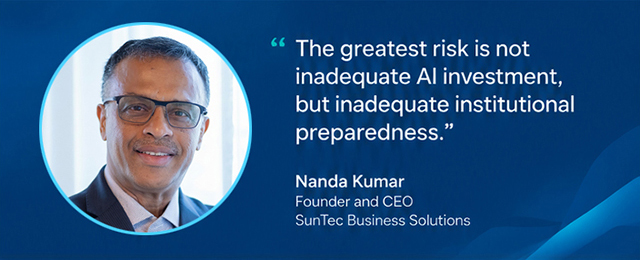
how AI improves everyday operations, rather than how many applications they introduce. Kumar says: “The greatest risk is not inadequate AI investment, but inadequate institutional preparedness.”
He adds that banks must ensure that employees can assess AI-generated recommendations, question their conclusions and exercise judgment. Clear controls around data privacy, regulatory compliance and accountability are equally important as the technology becomes more closely involved in business decisions.
For Kumar, the number of AI projects a bank launches is not a reliable measure of progress. Banks need to establish whether these initiatives improve decision-making, reduce operating costs, increase revenue, minimise errors and deliver better customer experiences.
He also highlighted the importance of retaining and reusing what banks learn from individual deployments. Validated knowledge, capabilities and implementation patterns can help subsequent projects move faster, rather than forcing each team to start from scratch. “The real question is whether AI is making the bank more efficient, responsive, intelligent, and competitive,” he says.
This requires banks to look beyond automating existing tasks. Applying AI to an inefficient process may accelerate existing problems rather than resolve them.
He adds: “The greatest productivity gains will come not from doing the same things faster, but from eliminating unnecessary work, simplifying complexity, and enabling better decisions across the organisation.”
Embedding intelligence into banking workflows
For AI to become part of day-to-day banking operations, it must be integrated into existing workflows rather than introduced as another standalone application for employees to operate.
Kumar pointed to SunTec XConnect as an example of an intelligent mediation layer that can interpret different data structures, apply business context and translate fragmented information into inputs for downstream processes.
Such an approach can help banks connect existing systems without having to replace them all. It may also help address a growing concern as banks introduce multiple AI models and agents across different systems producing inconsistent interpretations of the same information.

Central Bank of the UAE ... strong data practices and oversight
Kumar says banks need common standards for interpreting data, alongside clear decision-making responsibilities and mechanisms for tracing how outcomes are reached. Employees must also know when to rely on a recommendation and when further review is necessary.
However, integration alone is not enough. Banks must establish who is accountable for AI-influenced decisions, define boundaries for autonomous actions and monitor systems after deployment. Controls should also reflect the risk associated with each application.
“The objective is not to slow AI adoption with layers of bureaucracy. It is to build accountability into the way AI is designed, deployed, and monitored, so that scaling AI does not mean scaling uncertainty along with it,” he says.
Modernising without waiting for perfection
According to Kumar, banks do not need to replace every legacy system or consolidate all their data before expanding AI. Instead, they should focus on the requirements of each business priority, including reliable data, security controls and integration with the systems involved in a process.
Cloud infrastructure can provide the computing capacity and flexibility required for AI workloads, but moving to the cloud will not, by itself, resolve problems with data quality or disconnected processes.

Kumar says banks should modernise selectively while developing capabilities that can be reused across the organisation. “Scaling AI is not a destination you reach after modernisation; it is a capability you build progressively as the bank modernises,” he says.
For Gulf banks, this also means moving beyond isolated projects. Kumar cited the Central Bank of the UAE’s work on enterprise data management and governance, alongside its evaluation of AI across multiple areas, as an example of the region’s focus on stronger data practices and oversight. He says banks should treat each implementation as part of a wider capability, building common controls and reusable foundations that can support subsequent deployments.
Turning foundations into competitive advantage
The commercial implications are particularly significant for GCC banks facing changing economic conditions, regulatory requirements and customer expectations.
Kumar says AI should deliver more than operational efficiencies. It can help banks anticipate customer needs, refine pricing, identify revenue opportunities, improve margins and respond more quickly to market changes. Achieving these outcomes, requires banks to connect AI capabilities to everyday operations and their wider priorities.
Institutions that build reusable foundations can apply lessons from one implementation to the next, while avoiding unnecessary duplication and complexity. Those that focus primarily on accumulating tools and pilots risk missing the broader opportunity.
“Ultimately, the winners will not be those deploying the most AI, but those converting intelligence into superior customer value, greater competitiveness, and sustainable profitability,” Kumar says.